The Importance of a Timekeeping Checklist Policy
A timekeeping checklist is more than just a form to fill out; it’s a foundational tool for clarity and accountability. Whether you’re an individual juggling personal projects or a business owner managing a team, tracking time accurately is essential. A Timekeeping Checklist Policy establishes the framework for how this tracking should be done, ensuring consistency and reliability in your records.
What is a Timekeeping Checklist Policy?
In simple terms, a Timekeeping Checklist Policy is a set of guidelines paired with a practical template—a form—that standardizes how time is recorded. It defines what information needs to be captured, such as date, start and end times, activity descriptions, and notes. The policy ensures everyone follows the same process, which is crucial for fairness, payroll accuracy, and productivity analysis.
The core value lies in its structure. Instead of relying on scattered notes or memory, you use a consistent checklist. This transforms vague estimates into precise data. For businesses, this policy is often part of formal HR documentation, but its principles are equally powerful for freelancers, students, and hobbyists.
Key Features and Practical Benefits
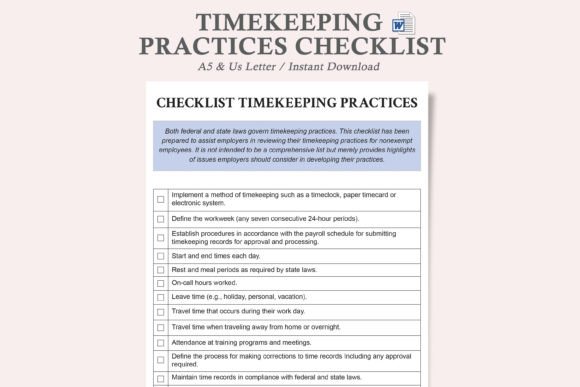
A well-designed timekeeping checklist template comes with features that make it easy to adopt. The best templates offer both editable formats, like a Word document, and printable PDFs. This flexibility allows you to customize it for your specific needs or print it for quick, offline use.
- Professional & Minimalist Design: An ink-friendly, clean layout isn’t just about looks; it reduces clutter and focuses attention on the essential data.
- Multiple Formats & Sizes: Having versions in both A5 and US Letter sizes means you can choose what fits your workflow—a compact notebook size or a standard sheet.
- Digital Download Convenience: The process is straightforward: purchase, download, and either print or use digitally. This immediate access saves time and lets you start tracking right away.
The real appeal is how it solves common problems. For employees, it clarifies clock-in and clock-out procedures, protecting against payroll disputes. For managers, it provides a clear audit trail. For solo creators, it turns “I worked on it all day” into “I spent 3.5 hours on design and 2 hours on research,” enabling better project planning and pricing.
Diverse Applications Across Lifestyles and Careers
The utility of a Timekeeping Checklist Policy spans far beyond traditional office settings. Its adaptability is key to its widespread value.
For Freelancers and Solopreneurs
Tracking time is directly linked to income. Using a checklist helps you bill clients accurately, identify tasks that consume disproportionate time, and set realistic deadlines for future work. An editable template lets you add columns for client names or project codes.
For Small Business Teams
Implementing a standardized policy ensures all employees record their hours uniformly. This is vital for calculating overtime, managing paid breaks, and ensuring compliance with labor laws. It also fosters a culture of transparency and responsibility.
For Personal and Creative Projects
Whether you’re learning a new skill, writing a blog, or managing a home renovation, a timekeeping checklist helps you stay disciplined. Seeing your time logged creates a sense of accomplishment and reveals patterns—maybe you’re most productive in the morning, or certain tasks always take longer than planned.
For Educators and Students
Teachers can track time spent on lesson planning, grading, or student consultations. Students can use it to manage study sessions across different subjects, ensuring balanced effort and avoiding burnout.
Implementing Your Timekeeping Checklist
Adopting this tool is a simple, but impactful, step. Once you have your template, the process is intuitive. Print a fresh page whenever you need one, or keep the digital file open on your computer. Fill in the checklist as you go, not at the end of the day, to capture the most accurate details.
Important considerations before you begin:
- Define Your Categories: Think about what you need to track beyond just “work.” Will you include breaks, travel, administrative tasks, or creative brainstorming?
- Choose Your Medium: Decide if a printed form on your desk or a digital file on your tablet works better for your environment.
- Set a Review Routine: The data is only helpful if you analyze it. Schedule a weekly or monthly review to see where your time is actually going.
Remember, the goal of a Timekeeping Checklist Policy is not to micromanage every minute, but to create awareness and intentionality. It turns time from an abstract concept into a measurable resource you can manage and optimize.
Moving from Tracking to Improving
Once you’ve consistently used your checklist for a few weeks, you’ll start noticing trends. You might discover that certain meetings always overrun, or that your most valuable creative work happens in shorter, focused bursts. This data empowers you to make changes—restructuring your schedule, delegating tasks, or setting clearer boundaries.
For businesses, this aggregated data can inform staffing decisions, project budgeting, and operational improvements. The policy ensures the data collected is standardized and reliable, making these high-level analyses possible.
Ultimately, a timekeeping checklist is a bridge between intention and action. It provides the concrete evidence needed to support better decisions, whether you’re aiming to increase personal productivity, grow a business, or simply gain a clearer understanding of how you spend your days.