Understanding Employee Contact Lists and Contact Forms
In the daily operation of any business, efficient communication is paramount. At the heart of this internal communication lies a fundamental, yet often underappreciated, tool: the employee contact list. An employee contact list is a centralized record containing key contact information for members of an organization. Typically paired with or referenced by a contact form—a structured method for collecting or updating this data—it serves as a critical resource for human resources and management.
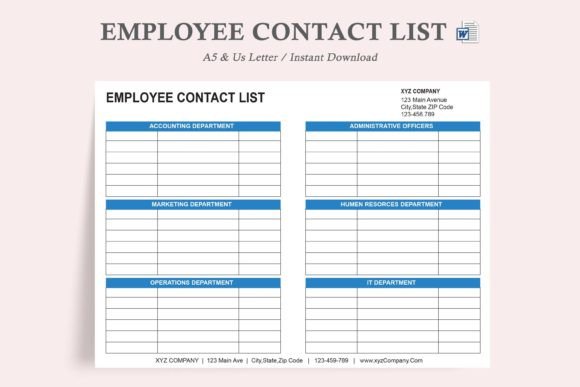
An employee contact list template provides a standardized framework for this information, commonly including fields for full name, job title, department, office location, phone numbers, email address, and sometimes emergency contact details. When this template is provided as an editable Word form or PDF, it allows companies to tailor and maintain the directory without specialized software. This combination of a static list and a dynamic form for updates creates a simple, yet effective, system for managing contact information.
Why Organizations Prioritize Employee Contact Management
People researching employee contact list templates are often tasked with improving organizational efficiency or compliance. The interest stems from several practical needs. Firstly, in emergency situations, immediate access to accurate employee information is not just convenient—it is a safety imperative. Secondly, day-to-day operations rely on swift communication for coordination, meeting scheduling, and project collaboration. A reliable contact list eliminates time wasted searching for correct email addresses or phone extensions.
Beyond internal communication, a well-maintained company directory supports human resources functions. It facilitates onboarding new hires by providing them with team details, aids in payroll and benefits administration, and ensures official communications reach all staff. For smaller businesses or teams without integrated HR software, a professionally designed, editable template becomes a foundational document, bridging the gap between informal methods and complex digital systems.
Key Benefits and Practical Advantages
The primary benefit of implementing a formal employee contact list and form system is centralization. Information scattered across individual email contacts, chat profiles, and paper notes is consolidated into a single, authoritative source. This reduces errors and ensures consistency. The use of a template, especially one featuring a minimalist, ink-friendly design, promotes clarity and ease of use, whether printed in A5 or US Letter size or distributed digitally.
A significant advantage of editable formats, like Word or PDF, is flexibility. Organizations can add or remove fields to suit their specific structure, such as including instant messaging usernames or remote work locations. The ability to print new pages as needed offers a simple solution for growing teams. Furthermore, maintaining this list underscores a commitment to data governance, ensuring that sensitive contact information is managed responsibly and updated regularly through a designated contact form process.
Tradeoffs and Important Considerations
While a template-based approach offers simplicity and low cost, it comes with inherent tradeoffs. The most notable is the manual effort required for upkeep. An editable Word template must be updated by someone, saved, and redistributed after each change. This can lead to version control issues if multiple copies circulate. Without a strict update protocol, the list can quickly become outdated, diminishing its utility and potentially compromising emergency preparedness.
Security is another vital consideration. A document containing personal employee details, even if just phone numbers and emails, must be stored and shared securely. A digital PDF download stored on a shared drive may pose risks if access permissions are not properly managed. Organizations must evaluate whether their chosen method aligns with their data protection policies. Additionally, a static document lacks the interactive features of dedicated software, such as automatic synchronization with company email systems or self-service update portals for employees.
When a Template is a Strong Fit
An editable employee contact list template is an excellent solution in specific scenarios. Startups, small businesses, and non-profit organizations with limited budgets and simpler structures often find it a perfect fit. It provides immediate organization without subscription fees or IT deployment. Teams that are largely co-located and have stable membership may not need complex software; a printable PDF posted in a common area could suffice.
It is also a strong candidate for temporary projects, event planning committees, or newly formed departments needing a quick communication solution. The professional design of a good template lends an official tone to internal documents, which can be important for establishing operational standards. In essence, when the need is for a straightforward, human-readable record that is easy to create and modify, a well-crafted template combined with a simple contact form for collecting updates meets the requirement effectively.
Situations Warranting Alternative Solutions
As organizations scale, the limitations of manual document management become more pronounced. Companies with a large, distributed, or rapidly changing workforce should consider alternatives. Dedicated HR information systems or integrated communication platforms often include dynamic employee directory modules. These systems can offer real-time updates, advanced search functions, and integration with other tools like calendars and instant messaging.
Furthermore, if security compliance is stringent—such as in healthcare or finance—a more controlled system with audit logs and restricted access may be necessary. For companies already using comprehensive suites like Microsoft 365 or Google Workspace, leveraging the built-in people directories might be more efficient than maintaining a separate Word document. The decision hinges on weighing the ongoing administrative overhead against the cost and complexity of a more automated solution.
Practical Insights for Decision-Making
When evaluating whether an employee contact list template aligns with your needs, ask practical questions. How frequently does your team's contact information change? Who will be responsible for updates, and what process will they use? Is your primary need for reference, emergency use, or both? Consider starting with a template even in larger organizations as a transitional tool to define your data fields and requirements before migrating to software.
Remember that the tool, whether a simple contact form and list or a sophisticated database, serves the goal of reliable communication. The most elegant solution is the one that gets consistently used and updated. If a printable, ink-friendly design encourages regular distribution and verification in team meetings, it might outperform a neglected digital system. Ultimately, the value lies not just in having the information, but in establishing a sustainable habit of maintaining it. By understanding the benefits, tradeoffs, and specific scenarios, you can select a contact management approach that truly supports your organizational goals and operational rhythm.