Choosing the Right Financial Record Tool: Evaluating a Ledger Book Income Expense Logbook for KDP
Managing finances, whether for a small business, a freelance venture, or a personal side project, requires a reliable system for recording transactions. For many, the foundational tool for this task remains the physical ledger book. Products like the Ledger Book Income Expense Logbook KDP represent a modern take on this classic format, designed specifically for self-publishing platforms. Understanding its distinct characteristics, and how it compares to other methods of record-keeping, is crucial for anyone deciding on the best tool for their financial organization.
The Distinct Design of a KDP Ledger Book
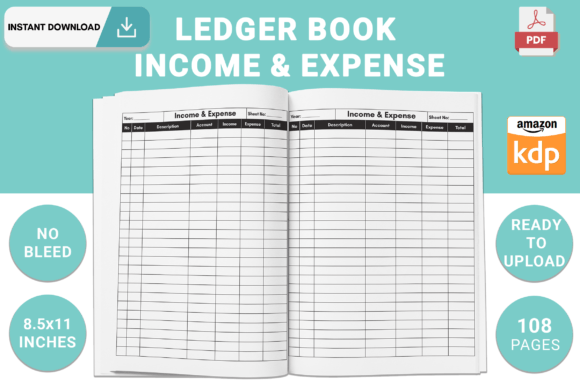
The Ledger Book Income Expense Logbook KDP is more than just a generic notebook. It is a purpose-built, print-ready template with dimensions of 8.5” x 11” and a page count of 108 pages, structured to facilitate systematic tracking of income and expenses. Its minimalist design avoids decorative elements or complex graphics, focusing instead on clean lines and clear spaces for data entry. This "no bleed" specification ensures that the printed content remains safely within the margins, a technical consideration vital for professional printing through services like Amazon's Kindle Direct Publishing (KDP).
What sets this apart from a standard accounting book bought off a shelf is its digital origin and customization potential. It exists as a file—ready to be printed personally or uploaded directly to a print-on-demand service. This allows for a degree of control; you can assess the entire layout before committing to a physical copy. The design is intentionally straightforward, prioritizing function over form, which can be a significant benefit for users who need clarity and efficiency without distraction.
Comparing Physical Ledgers with Digital Alternatives
When evaluating the Ledger Book Income Expense Logbook KDP, it's essential to consider the broader landscape of financial tracking tools. The decision often hinges on a fundamental choice: physical versus digital.
Physical ledger books, like this KDP-ready logbook, offer tangible, offline reliability. There is no software to learn, no subscription fee, and no concern about data breaches or platform changes. Writing entries manually can reinforce mindfulness and understanding of one's cash flow. For small businesses with simple transaction volumes, or for individuals who prefer a hands-on approach, a well-designed ledger can be perfectly adequate. The act of manually compiling totals at the end of a month can also serve as a valuable review exercise.
Digital tools, ranging from spreadsheet software to dedicated accounting apps, present a different set of advantages. They automate calculations, generate instant reports, and can handle vastly larger volumes of data with ease. They facilitate sharing with accountants, backup to cloud services, and integration with bank feeds. The tradeoff, however, involves ongoing costs, dependency on technology, and often a more complex interface that requires time to master.
The Ledger Book Income Expense Logbook KDP fits into a specific niche within this comparison. It is a physical tool born from a digital file, offering the permanence and simplicity of paper while leveraging the accessibility and distribution model of modern self-publishing. It is not trying to compete with the automation of QuickBooks or the flexibility of Excel, but rather to serve as a optimized, dedicated container for manual entry.
Strengths and Potential Limitations
The strengths of this ledger book logbook are clear for certain use cases. Its 108-page count provides substantial space, likely sufficient for a year of records for a modest operation. The large page size allows for spacious columns, reducing clutter and improving readability. The minimalist design minimizes cognitive load, directing focus entirely to the numbers. For a solopreneur, a craft seller on Etsy, a landlord managing a single property, or a hobbyist tracking project costs, this organized simplicity can be a significant benefit.
However, its limitations become apparent when transaction volume or complexity escalates. If your business involves hundreds of entries per month, multiple income streams, intricate inventory, or requires frequent profit-and-loss statements, manual entry in a ledger becomes time-consuming and prone to human error. The static nature of a printed book means you cannot easily search, filter, or reorganize data retrospectively. There is no automatic backup; loss of the physical book means loss of all records. Furthermore, while ready for KDP, it is a fixed template. You cannot dynamically add columns for specific tax categories or adjust the layout mid-year without starting a new book.
Decision Factors: When Is This Ledger the Right Fit?
Choosing the Ledger Book Income Expense Logbook KDP depends on several practical factors related to your workflow, business size, and personal preferences.
- Volume and Complexity: It is best suited for low-to-medium transaction volumes. If you record fewer than 50-100 entries per month, and your categories are relatively straightforward (e.g., "Sales," "Supplies," "Utilities"), this ledger can handle the task efficiently.
- Desired Process: If you value a tactile, deliberate recording process that separates financial review from your digital work environment, a physical ledger offers a distinct psychological and practical boundary.
- Budget and Tech Comfort: It presents a low-cost, one-time investment with no technical learning curve. This is advantageous for those wary of subscription software or who prefer to keep their financial records completely offline.
- Need for Portability and Sharing: While a book is portable, sharing data requires photocopying or manually transferring totals. If you need to send detailed, real-time reports to a partner or accountant regularly, a digital file is more practical.
Consider a realistic example: a freelance graphic designer. They might have income from a few clients per month and expenses for software subscriptions, marketing, and office supplies. The Ledger Book Income Expense Logbook KDP could provide a clear, central place to log these, aiding in quarterly tax estimation. However, if that designer expands to a small agency with multiple contractors, client invoicing, and project-based costing, the limitations of manual logging would quickly necessitate a move to digital accounting software.
Exploring the Spectrum of Alternatives
Understanding the Ledger Book Income Expense Logbook KDP also involves recognizing the range of alternatives within both the physical and hybrid realms.
Other physical options include pre-bound commercial accounting books from office supply stores, which may offer similar layouts but with less control over the final print quality. There are also customizable blank notebooks where you draw your own columns, offering maximum flexibility but requiring significant setup time and lacking printed structure.
On the hybrid side, some users employ a "digital-first, physical-backup" system. They might use a simple spreadsheet template for daily entries and monthly calculations, then print and bind a summarized report into a physical archive. This approach combines digital efficiency with physical permanence, but it involves managing two systems.
The KDP-ready ledger sits uniquely between these. It offers a pre-designed, professional structure in a format you control from the digital stage to the physical outcome. It is a prepared template, eliminating the need to draw your own columns, while still being a tangible final product.
Tradeoffs and the Path to an Informed Choice
The core tradeoff in opting for this or any physical ledger is the exchange of automation and scalability for simplicity, tangibility, and cost control. You gain a focused, offline tool but lose the dynamic capabilities of software.
To make an informed decision, assess your current and anticipated needs. Map out a month's typical transactions. How many entries do you make? How many categories do you track? Do you need to calculate things like depreciation or payroll? Do you value the ability to quickly generate a chart or annual summary? If your answers lean toward low volume, simple categories, and a preference for manual control, the Ledger Book Income Expense Logbook KDP could be a highly effective resource. Its specific design for clean KDP printing also ensures you receive a professional-looking product if you choose to use print-on-demand services.
Conversely, if your operation is growing, requires complex reporting, or you already feel overwhelmed by manual calculations, exploring robust spreadsheet templates or dedicated accounting software would be a more prudent long-term investment. The key is to match the tool not just to your present situation, but to your realistic trajectory over the next year or two.
Ultimately, tools like the Ledger Book Income Expense Logbook KDP serve an important market segment that values organized simplicity. By providing a dedicated, well-structured space for financial data in a reliable physical format, it helps bridge the gap between completely informal recording and the world of formal digital accounting. Your choice depends on where your needs fall on that bridge.