Essay Planner and Essay Guide: Your Companion for Academic and Creative Writing
Staring at a blank document, the deadline looming, and a pile of research notes scattered across your desk—it’s a familiar feeling for many. Whether you’re a university student tackling a critical analysis, a graduate student drafting a thesis chapter, or a professional writing a detailed report, the process of structuring complex thoughts into a coherent, persuasive essay can be daunting. This is where the practical utility of an Essay Planner and Essay Guide comes into play. It’s not just a template; it’s a systematic approach to breaking down the monolithic task of writing into manageable, sequential steps.
What Exactly Is an Essay Planner and Guide?
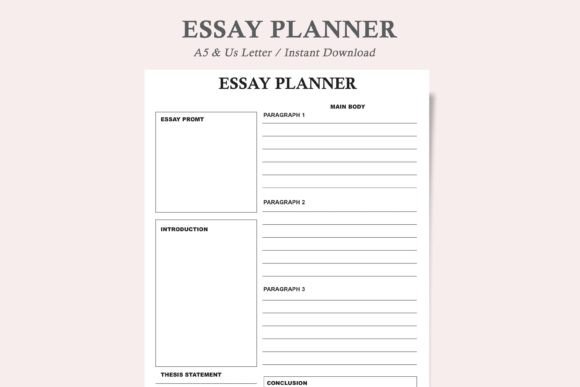
Think of it as a dedicated writing toolkit. The Essay Planner provides the scaffold—a structured template with sections for your thesis statement, main arguments, supporting evidence, and conclusion. It’s a visual map of your essay’s skeleton. The complementary Essay Guide offers the strategy, containing tips on developing strong arguments, avoiding common logical fallacies, integrating sources effectively, and polishing your prose. Together, they function as both an academic organizer and a writing coach, designed to move you from initial brainstorming to final draft with greater clarity and less stress.
Real-World Scenarios: Who Benefits and How?
The application extends far beyond the traditional undergraduate essay. Consider the graduate researcher who must synthesize years of data into a publishable paper. Using the planner’s framework, they can isolate key findings for each section, ensuring the narrative flow is logical before delving into dense writing. Similarly, a professional preparing a white paper or a complex business proposal can use the argument-organizing sections to ensure every recommendation is backed by solid evidence and presented in a compelling order for stakeholders.
Another powerful use case is for individuals returning to academia after a long hiatus. The structured approach can rebuild confidence by providing a clear path forward, mitigating the anxiety of “not knowing how to start.” The Thoughts Journal component, often integrated into such planners, is invaluable here. It allows for free-form brainstorming and capturing fleeting insights that might later become a central argument, separating the creative ignition phase from the structured assembly phase.
Navigating Different Projects and Personalities
Different writers face different challenges. A meticulous, detail-oriented person might benefit most from the planner’s ability to compartmentalize tasks—using the Assignment Planner and Research Tracker elements to set micro-deadlines for completing the outline, drafting section one, or finding three supporting quotes. This transforms an overwhelming project into a series of checked boxes.
Conversely, a big-picture thinker who struggles with organization can use the same tool to impose necessary discipline. The template forces them to define their thesis concretely before expanding, preventing the common pitfall of a rambling, unfocused draft. For collaborative projects, like group reports, the shared framework of a common planner ensures all contributors are aligned on the essay’s core structure and argument hierarchy, streamlining the integration of individual sections.
Practical Considerations Before You Begin
While a pre-designed Essay Planner and Essay Guide offers immense utility, its effectiveness depends on a few user choices. First, consider the medium. A printable PDF, with its professional and ink-friendly minimalist design, suits those who prefer a tactile, handwritten process—annotating margins, drawing quick connections between points. This can enhance cognitive engagement for many. Digital users might overlay the same structure in a note-taking app, gaining the benefit of searchability and easy rearrangement.
Second, honesty about your own weakest link in the writing process is key. If you consistently struggle with crafting a strong introduction, focus your energy on that section of the guide and planner. If time management is the issue, lean heavily on the integrated Writing Schedule and Project Planner features to block out dedicated writing sessions. The tool is adaptable; you don’t need to use every component, but rather the ones that address your personal bottlenecks.
The Strengths and Natural Limitations
The core strength of this system is its demystification of the writing process. It replaces ambiguity with a clear sequence: brainstorm, research, outline, draft, revise. This can significantly reduce procrastination and improve the quality of first drafts. The inclusion of a Student Planner and Assignment Planner also contextualizes the single essay within your broader academic workload, helping prioritize efforts.
A potential limitation, if misunderstood, is the perception of rigidity. A template is a guide, not a rigid cage. The best writers use such frameworks to ensure foundational solidity, then deviate creatively where needed. It shouldn’t stifle unique voice or unconventional structure if those serve your purpose. Also, while the planner provides the path, it doesn’t write the content for you. The hard work of thinking, researching, and crafting sentences remains—but now it’s work done on a stable, organized platform.
Beyond Academia: Creative and Professional Applications
The principles of structured planning apply to many forms of writing. A blogger developing a long-form investigative piece can use the essay outline to balance narrative, data, and analysis. A novelist might adapt the sections to plot a character’s arc or plan a critical scene’s beats. Even preparing for a important presentation or speech involves building a logical argument—the essay planner’s framework for thesis and supporting points translates seamlessly to this task. In essence, wherever you need to build a complex, persuasive case from a chaos of ideas, this toolkit offers a reliable methodology.
Ultimately, embracing an Essay Planner and Essay Guide is about embracing control over your own creative and intellectual process. It’s a choice to move from reactive scrambling to proactive, confident building. By externalizing the structure, you free your mind to focus on what matters most: the power and clarity of your ideas.