Organizing Knowledge: The Strategic Role of Structured Study Tools in Professional Fields
In fast-paced, information-intensive domains—from healthcare to technology—the ability to efficiently absorb, retain, and recall complex data is not just a study skill; it's a professional imperative. For nursing students, pharmacists, and other medical trainees, pharmacology represents one of these critical knowledge mountains. Mastering hundreds of drugs, their mechanisms, interactions, and implications requires a system beyond passive reading or random note-taking. This is where specialized tools like the Pharmacology Blank Study Template transition from simple notebooks to essential cognitive frameworks.
Beyond the Blank Page: What is the Pharmacology Blank Study Template?
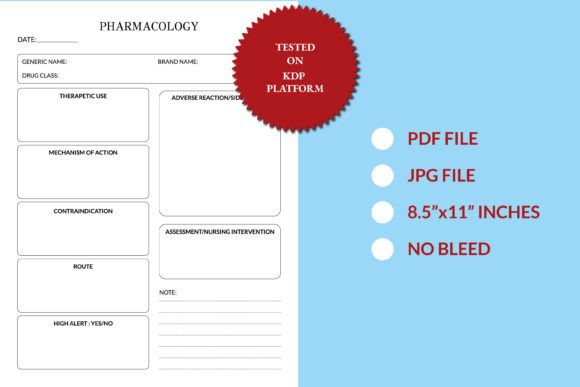
At its core, the Pharmacology Blank Study Template is a pre-structured note-taking system designed specifically for the subject of pharmacology. It transforms a blank page into a guided template with dedicated, labeled spaces for each crucial piece of drug information. Instead of starting from zero, the user fills in a consistent framework for every medication or drug class studied.
The template typically includes fields for:
- Generic & Brand Names
- Therapeutic Use & Mechanism of Action
- Contraindications
- Routes of Administration
- High-Alert Status
- Adverse Reactions & Side Effects
- Assessment Parameters
- Nursing Interventions
- Personal Notes
This structure, often formatted as an 8.5" x 11" PDF or printable template, ensures that note-taking is comprehensive, consistent, and revision-ready. It directly addresses the chaotic nature of pharmacological data by enforcing a uniform method of capture.
Alignment with Modern Professional and Educational Trends
The relevance of the Pharmacology Blank Study Template extends far beyond its pages. It sits at the intersection of several contemporary trends affecting professionals, creators, and learners across industries.
The Rise of Systematic Personal Knowledge Management (PKM)
In an era of information overload, individuals are moving from collectors of data to curators of knowledge. Tools like note-taking templates, digital databases, and second-brain systems are increasingly popular among entrepreneurs, researchers, and freelancers. The Pharmacology Blank Study Template is a focused, analog example of this trend. It helps users build a personal, authoritative reference library on a complex topic, mirroring the PKM strategies used in tech and business to manage projects, client information, or competitive research.
Demand for Active Learning and Cognitive Efficiency
Modern educational psychology emphasizes active engagement over passive consumption. Filling a structured template requires the learner to process information, make decisions about what fits in each category, and write it down—a process that dramatically improves encoding into long-term memory. For the nursing student facing relentless exams and clinical pressures, this efficiency is not a luxury; it's a necessity. The template turns studying into an active, consistent workflow.
Quality and Safety in High-Stakes Fields
Fields like healthcare are fundamentally error-intolerant. The "High Alert" field in the Pharmacology Blank Study Template is a direct reflection of this reality. It forces the learner to explicitly identify drugs that require special vigilance, connecting academic study directly to practical, life-saving application. This bridges the gap between theory and safety-critical practice, a concern also paramount in sectors like engineering, finance, and software development where oversight can lead to catastrophic outcomes.
Why Structured Templates Command Attention Now
The growing attention to tools like this pharmacology template speaks to changing needs in professional development.
First, the expectation of integrated workflows. Today's professionals often juggle digital and analog systems. A well-designed PDF template can be printed for handwritten study—which many find superior for memory—or used digitally on tablets with note-taking apps. Its tested compatibility with platforms like Amazon KDP indicates its readiness for both physical and digital distribution, meeting the hybrid workflow preferences of modern students.
Second, the preference for customization within structure. Unlike a rigid textbook, a blank template provides a framework without prescribing the content. The learner owns the information. This balance between guidance and flexibility is highly valued in today's creative and professional tools, from project management software to design canvases. It supports mastery without stifling personal insight or unique clinical observations that a student might add in the "Notes" section.
Practical Applications and Broader Implications
Consider a nursing student preparing for a pharmacology exam on cardiovascular drugs. Using the Pharmacology Blank Study Template, they approach each drug—say, Digoxin—with a clear, repeatable process. They systematically fill in its mechanism (inhibiting the Na+/K+ ATPase pump), its narrow therapeutic index (marking it as High Alert), key side effects like bradycardia, and specific nursing interventions like apical pulse assessment. This creates not just a set of notes, but a comparative database. During review, they can easily scan across dozens of such completed pages to contrast beta-blockers with calcium channel blockers, seeing patterns and exceptions laid out in identical formats.
This practical utility connects to larger developments in expertise acquisition. In many disciplines, the path from novice to expert involves developing robust mental schemas—organized structures for categorizing information. The Pharmacology Blank Study Template externally provides that schema during the learning phase, accelerating the internal development of the learner's own mental model for pharmacology. This principle is applicable to learning any complex system: coding languages, legal case types, marketing channel attributes, or even artistic techniques.
The Template as a Bridge Between Disciplines
While designed for pharmacology, the concept of a blank study template is universally portable. A graphic designer might create a template for client project briefs, capturing fields for brand history, target audience, color palette preferences, and deliverables. A software developer could use a template to document API endpoints, with spaces for method, parameters, authentication, and response formats. The success of the Pharmacology Blank Study Template underscores a universal need: in any field requiring mastery of detailed, categorical information, a predefined structure reduces cognitive load and increases accuracy and recall.
Conclusion: Embracing Structured Learning as a Professional Strategy
The Pharmacology Blank Study Template is more than a study aid; it is a manifestation of a smarter approach to mastering complexity. It aligns with the contemporary drive for organization, active learning, and workflow efficiency that resonates with professionals, creators, and serious enthusiasts across sectors. By providing a consistent framework for capturing critical data, it transforms a daunting subject into a manageable, personal knowledge base. For anyone tasked with learning and applying intricate information systems—whether in healthcare, business, technology, or the arts—the principle it embodies is invaluable: structure liberates cognition, and organization is the foundation of expertise.