Taking Control: Why a Job Search Tracker is Your Secret Weapon
Navigating a job search can feel like managing a complex, multi-layered project. Applications, follow-ups, networking contacts, and interview dates swirl in a disorganized cloud of emails, sticky notes, and mental reminders. It’s stressful, inefficient, and often leads to missed opportunities or duplicated efforts. This is where a dedicated Job Search Tracker transforms chaos into clarity. It’s not just a notepad; it’s a strategic management system designed to bring order, focus, and momentum to your career hunt.
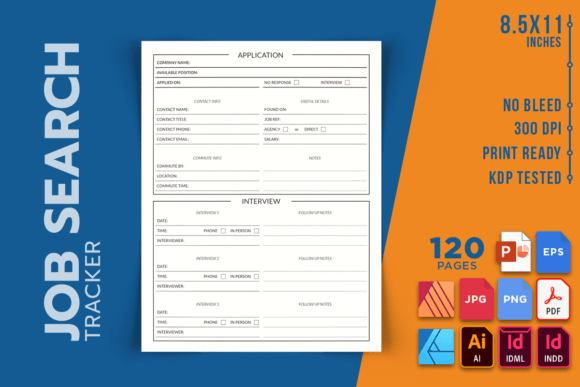
A well-designed Job Search Tracker provides a centralized framework to log every detail. Imagine having one reliable place to record the company name, position applied for, application date, key job requirements, contact person, and the status of your submission. This simple act of consolidation immediately reduces cognitive load, freeing your mind to focus on crafting better cover letters or preparing for upcoming interviews instead of scrambling to remember where you applied last Tuesday.
The Anatomy of an Effective Tracking System
What sets a professional Job Search Tracker apart from a blank sheet of paper? It’s the intentional structure. A quality tracker typically includes categorized sections that guide you through the entire process. You’ll find areas to document company research, allowing you to note cultural fit or growth potential before you even apply. There are dedicated pages for tracking sent applications, often with columns for the job ID, a link to the posting, and submission method.
Perhaps most crucially, a robust tracker includes follow-up and interview logs. This is where you plan your next actions: “Send thank-you email to Ms. Jones on Friday,” or “Prepare answers for technical round on Monday.” By scheduling these tasks alongside the application data, you create a proactive workflow rather than a reactive scramble. The physical or digital act of writing it down not only commits it to memory but also creates a tangible record of your progress, which can be a powerful motivator during a lengthy search.
From Overwhelmed to Organized: Practical Applications
The utility of a Job Search Tracker extends beyond just listing jobs. For the recent graduate, it serves as a learning tool, helping them identify which types of roles they apply to most frequently and which industries respond. For the seasoned professional seeking a career change, it becomes a strategic map, comparing opportunities across different fields in terms of salary ranges, required skills, and geographic locations.
Freelancers and consultants, who often juggle multiple potential projects or client engagements, can adapt the tracker to monitor proposal submissions and client communications. Educators transitioning out of academia can use it to track applications to corporate training roles, non-profits, or publishing houses, maintaining separate sections for each career path they’re exploring. The core function—centralizing dispersed information—is universally valuable.
The Tangible Benefits of a Structured Approach
Adopting a Job Search Tracker yields immediate and long-term advantages. The most obvious benefit is increased efficiency. You save hours previously wasted searching through your inbox for a confirmation email or trying to recall the name of the hiring manager. This efficiency translates directly into productivity, enabling you to manage more applications with higher quality, as you’re not fatigued by administrative clutter.
There’s a significant psychological benefit as well. A visual record of your activity—seeing pages filled with applications, follow-ups, and even rejections—provides a realistic picture of your effort. It combats the feeling that “nothing is happening,” because the tracker shows concrete evidence of your work. This can maintain morale and determination. Furthermore, during an interview, you can quickly reference your tracker to speak confidently about why you applied, what you know about the company, and your previous communication with them, projecting a prepared and professional image.
Selecting and Implementing Your Tracker
When choosing a Job Search Tracker, consider your personal workflow. Do you prefer a physical notebook you can carry, or a digital file you can access anywhere? The product described, with its 120-page 8.5 x 11 inch format and inclusion of editable source files like INDD or AI, offers flexibility. You can print it and use it as a binder, or customize the digital file in software like Adobe Illustrator to add personal branding or remove sections you don’t need.
Key practical considerations include the layout’s logic. Does the flow from research to application to follow-up feel natural? Are there enough rows and columns for a potentially long search? The availability of high-quality PDF and other file types ensures you can use it in any environment, from printing at home to taking it to a professional print shop, without loss of quality. The “no bleed” specification confirms it’s perfectly formatted for standard home printers, making immediate use simple.
Implementation is straightforward but requires discipline. Start by entering every current application, even the ones from last week, to populate your tracker with a baseline. Commit to updating it immediately after any job search activity: right after submitting an application, right after a networking call. Treat it as the official logbook of your project. Review it weekly to analyze your patterns—are most opportunities coming from one platform? Are you getting more responses from a certain type of role? This data becomes invaluable for refining your strategy.
Beyond the Search: Long-Term Value and Adaptation
A Job Search Tracker’s value doesn’t necessarily end when you accept a position. The completed document becomes a record of your career journey. You can refer back to it to remember which companies you’ve researched, what skills were frequently required in your target roles, and how your interview performance evolved. This information is gold for future career moves or when mentoring others.
The structure can also be adapted for related purposes. The same principles of tracking applications, contacts, and follow-ups can be modified for tracking freelance pitches, academic grant proposals, or even content submissions for bloggers and writers. The core design philosophy—centralized, categorized logging of a multi-step process—is widely applicable. By owning the editable source files, you have the power to modify this tool for life’s other complex campaigns, turning a single-purpose tracker into a versatile personal management system.
In a competitive job market, organization is a non-negotiable advantage. A dedicated Job Search Tracker provides that advantage in a concrete, actionable form. It replaces anxiety with order, transforms random effort into a strategic campaign, and gives you the clear-eyed control needed to navigate your career path successfully. Whether you’re a first-time job seeker or a veteran professional contemplating a change, implementing this simple system can be the most productive first step you take.